The sunrise above was photographed at Harns Marsh Preserve in December 2010.
That didn't deter me from an attempt to have a very rewarding time observing the wildlife which I did.
The first active flight observed was that of Roseate Spoonbill from the area where Limpkin are sometimes seen while always heard.
 The Roseate Spoonbill above was photographed at Harns Marsh Preserve in December 2010.
The vultures were seen across the lake on the ground perhaps in their attempt to stay warmer while they're typically observed in the trees at first light.
A juvenile Great Blue Heron was very docile seemingly waiting for the sun to warm its bones.
 The Great Blue Heron juvenile above was photographed at Harns Marsh Preserve in December 2010.
Limpkin were observed in flight more so than I had observed at Harns Marsh before.
This species has a tendency to stay very low to the ground even while in flight.
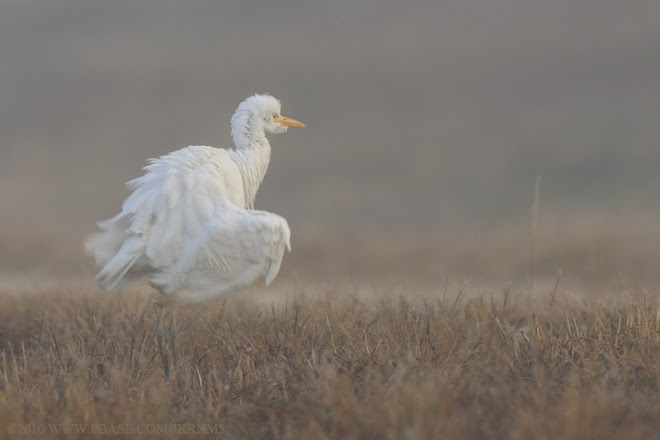 The Cattle Egret above was photographed at Harns Marsh Preserve in December 2010.
Snail Kite were active in their search of Apple Snails shortly before the fog burned off.
Osprey were again observed hunting successfully for their prey.
 The Glossy Ibis above was photographed at Harns Marsh Preserve in December 2010.
What would become a remarkable observation for me was an inbound flight of a solitary Sandhill Crane that landed directly in front of me from the north.
As I observed this bird in amazement, two more cranes were walking toward me along the marsh's frontage road and emerged from the fog a short while later.
 The Snadhill Crane above was photographed at Harns Marsh Preserve in December 2010.
Before the Sandhill Cranes arrived, a small flock of Cattle Egret appeared to become active from their slumber.
It was at this time that I was chiding myself for failing to bring the flash and Better Beamer.
 The Snadhill Crane above was photographed at Harns Marsh Preserve in December 2010.
Always have them at the ready in case they're needed if you have them.
It was a special occasion to meet Hemant Kishan again at the preserve.
 Hemant Kishan above was photographed at Harns Marsh Preserve in December 2010.
Hemant, a prolific American Birding Association contributor, was intently observing an American Bittern that he sighted at relatively close range.
He was kind enough to point my camera in the direction of the bird at one point as the bird was so well camouflaged in the reeds.
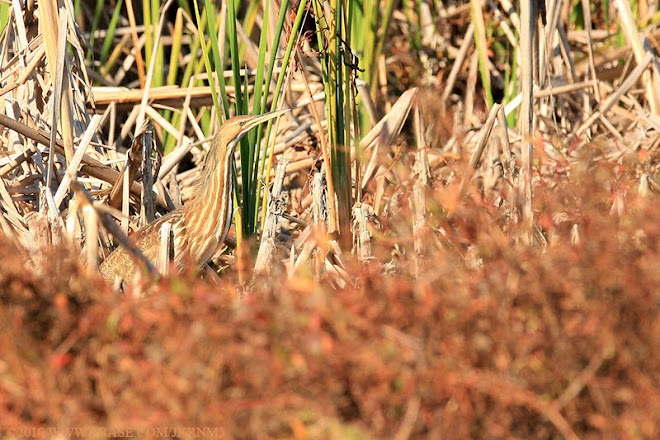 The American Bittern above was photographed at Harns Marsh Preserve in December 2010.
Hemant mentioned his interest in Celery Fields which he believes best visited in September.
It was interesting to observe a scuffle between a pair of Anhinga while the Tree Swallows seemed to be in lesser numbers than usual.
 The Anhinga with Pied-billed Grebe above was photographed at Harns Marsh Preserve in December 2010.
The same pair of Great Egret observed a couple of weeks earlier offered their same repose in nearly the exact same spot I had last seen them.
Since my visit to Harns Marsh Preserve this week, I have read that the Crested Caracara is often seen in flight in the presence of vultures.
 The Limpkin above was photographed at Harns Marsh Preserve in December 2010.
When I visit the preserve again, my first objective will be to scan the trees where the vultures are typically resting before they fly off to take advantage of the thermals in the absence of wind.