Tuesday, March 2, 2010

African shoebill baby update

Mom and baby.


Baby looking around. The baby really has grown. It looks like mom only with fuzz instead of feathers.

Mom checking out the egret on the far left that must have been paying a visit.


Baby looking up at mom. It looks like it could be smiling.

This weekend I went to see if the baby African shoebill stork at Lowry Park Zoo was old enough to be visible through 2 fences. It was born on Christmas day. At nine weeks old I was able to get some not so great pictures since I had to take them through the fences. The African shoebill stork family lives in the big aviary in the African section of the zoo. These are very rare birds and this baby is the 2nd in the world to be born in captivity and the 1st in the US. The zoo says the parents are doing great for being first time parents. There is another couple there and the zoo hopes they will follow and nest as well. I'll be checking back in a few weeks to see if the baby is walking or flying around.

Sunday, February 28, 2010

Little birds at Boyd Hill

Blue grey gnatcatcher


Northern mockingbird


My first yellow rumped warbler sighting.


Yellow rumped warbler showing his yellow.
Boyd Hill park is full of little songbirds this time of year. There were thousands flying around constantly. As I was walking down the trail through the woods away from the lake they were flying back and forth across the trail. These guys are really hard to catch on camera. They don't stay still very long. I saw all of the above as well as a few cardinals, lots of palm warblers, blue jays and tons of other birds I didn't recognize. There are also a lot of the below all over the park. Since the water has been so cold they were all over the trails.


Friday, February 26, 2010

Feature: Florida Burrowing Owl

On the eve of the 8th annual Burrowing Owl Festival in Cape Coral, Florida, I made my fifth attempt to observe and document the sub-species of Burrowing Owl that is thought to have in excess of 2500 nests in the city.

The Burrowing Owl above was photographed at the Cape Coral Library in February 2010.

I can't imagine a more fortuitous time to finally see the species and spend more than two hours observing its nest and what I would describe as an early riser (in the late afternoon).

All previous visits to Cape Coral with the hope to see the Burrowing Owl were met with failure.

The Burrowing Owl above was photographed at the Cape Coral Library in February 2010.

I had earlier considered stopping by Brian Piccolo Park, in Cooper City, Florida, while traveling through the Great Florida Birding Trail's Night-Heron Cluster to otherwise see the park's reliable nests and sightings of the owls.

Tim Rucci's sighting of the Burrowing Owl at Piccolo Park can be
seen here.

The Burrowing Owl above was photographed at the Cape Coral Library in February 2010.

Time constraints led to my postponing my attempted sighting of the owls on Florida's east coast with greater hopes of seeing the species closer to home on Cape Coral within the official nesting season which occurs 15 February through 10 July.

This species I would highly recommend you seek out when you have the chance as they are so photogenic or are simply fun to watch.

The Burrowing Owl above was photographed at the Cape Coral Library in February 2010.

The Burrowing Owl is very prevalent in Imperial Valley which is home to about 70 percent of California’s Burrowing Owl population.

When I encountered the owl that I considered much more diminutive than I had expected, I made an immediate planting of my presence to it.

The Burrowing Owl above was photographed at the Cape Coral Library in February 2010.

More than 90 minutes had passed before the mate of the bird I was observing emerged from the nest.

The bird first observed I consider to be the male based on my research of it for a couple of reasons.

The Burrowing Owl above was photographed at the Cape Coral Library in February 2010.

It is thought that the male spends more of its time outside of the nest and thus has a more "bleached" color to its feathers compared to the female otherwise very similar in appearance.

The female is slightly larger in size and therefore best distinguished when observing the mates together.

The Burrowing Owl above was photographed at the Cape Coral Library in February 2010.

I am quite sure that my first Burrowing Owl observed was the male as it was certainly smaller than the other that finally made its way out of the nest at sunset.

The action around the setting of the sun became a lot more exciting.

The Burrowing Owl above was photographed at the Cape Coral Library in February 2010.

Both feeding and copulation behavior were observed.

Although the nest observed is on a relatively lightly traveled side street adjacent to the library, the birds seemed to be alert to on occasional car passing or the bark of a dog.

The Burrowing Owl above was photographed at the Cape Coral Library in February 2010.

What I found even more interesting was that the birds seem to have extraordinary eyesight in their alertness to see what was flying overhead.

I was not able to react to the birds as quickly as I would have liked to capture some of the more entertaining postures of the creatures.

The Burrowing Owl above was photographed at the Cape Coral Library in February 2010.

As the light diminished and then seemed to disappear, the birds became the most active, and I'm quite sure I observed the birds mating if only so briefly for a few seconds.

It was near darkness when this activity occurred, so I was relying more on the camera to see than myself.

The Moon above was photographed at the Cape Coral Library in February 2010.

The shutter speeds were not very reliable for a focused shot in the end.

My preparation for this event included the reading of world renowned photographer Artie Morris's The Art of Bird Photography, where I was able to set the camera lens to its best performance capability.

The Burrowing Owl above was photographed at the Cape Coral Library in February 2010.

I knew I would have to leave the nest site at some time, but stayed until the lens would no longer focus on the action.

That was really late again, nearly 30 minutes after sunset, when I attempted to capture my last shots to present to you.

Big birds at Boyd Hill

Cormorant drying off.


Snowy egret braving the cold wind.


This lone white pelican was flying around. They are usually with large groups so I'm not sure where the rest of his friends where.


A tricolored heron and blue heron hang out together.


This turkey vulture was showing off.


I took a long walk around Boyd Hill Park in St. Petersburg this past Saturday. The day started off windy, a little cool and cloudy with a chance of rain. There didn't seem to be a lot of birds around. I ran into a couple from England who came over for a couple of weeks for vacation and they asked me where were all the birds. He had a camera with him and said they come every year at this time and in the past the parks have all been full of big water birds. He said they had not seen a lot of birds anywhere they had been since middle of January. I have been asking myself the same question. I'm assuming the much colder than usual temperatures has pushed them further south. I'm not sure if south Florida is seeing an influx of birds more than usual. Hopefully once the weather warms up a bit for a while the big birds will show up again.

Wednesday, February 24, 2010

Birds at Circle B Bar Reserve


This anhinga caught a big fish. They must have really expandable necks because he swallowed this whole after banging it around on the branch a few times.


Blue winged teals swimming around.


Palm warbler sitting in the bush.


Blue grey gnatcatcher. These are pretty birds but hard to catch on camera.


Last week I was on my way back to Tampa from Orlando and decided to stop by one of my favorite places, Circle B Bar Reserve, in Lakeland. It was pretty quiet during the week and it was the first time I had been there late in the afternoon. Not a lot of wildlife activity going on there. The hundreds of white pelicans were missing. There were only a few at the far end of the pond. There wasn't a single bird in the bird pond where the big alligator, Bubba, lives. I managed to find a few smaller birds flying around. There was a huge flock of tree swallows flying everywhere but those guys are almost impossible to get a picture of. They fly really fast and never seem to land on anything. It was a beautiful day out and I had a good walk as usual there.

Monday, February 22, 2010

Friends and enemies - more from Gatorland


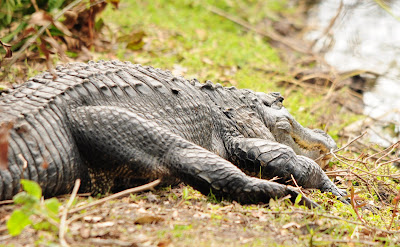
You would wonder why these birds would sit so close to these large beasts. They are really just waiting to try and get some of the food that is fed to the alligators.


This egret must have thought he was standing on a log instead of an alligator's tail.


I'm sure this great blue heron could have flown away if the alligators actually moved. Although that alligator behind him sure was smiling at him.


Occasionally a bird gets too close to a hungry alligator. I heard the splashes and looked over to see this alligator swimming around with his prize lunch.

There are two main things you see at Gatorland - lots of big alligators and big wild water birds. For the most of time they seem to co-habitat well together. The birds hang around the ponds at Gatorland to catch crumbs of the food being fed to the alligators and because there is lots of fish in the ponds for them to eat. The alligators keep away raccoons that would eat the bird eggs. I did happen to catch nature happening while I was there when an alligator must have been hungry and a bird got lazy and too close. It's a sad circle of life.

Saturday, February 20, 2010

Great egrets nesting

Doing a mating dance.

Sitting on the nest. There aren't any babies yet but they will be coming soon.

These two egrets were courting each other for a while.

Egrets were busy getting sticks for their nests.


Saturday morning I went to Gatorland. Not to see the alligators, although there will be pictures of those coming. Bird nesting season has started there. They have a bird rookery there that is amazing during this time through spring. The mangroves along the boardwalk were full of great egrets (who apparently are the first type of these birds to nest). Last year I went in early May and the place was full of tricolor herons and blue herons with babies. During mating season great egrets get bright green color around their beaks that you don't see in the summer and fall. They do these strange mating dances that are fun to watch. The rookery was buzzing with egrets gathering sticks, flying around getting food and fixing their nests. They nest there because they seem to know that the alligators in the lake below will keep the raccoons from getting their eggs. I plan to go back in late March to see if any babies have hatched.